核心观点
作者主张将溶瘤病毒视为原位疫苗平台:在肿瘤内部释放抗原、启动免疫,再推动效应细胞进入病灶。 评价重心由单纯增加浸润,转向肿瘤特异性免疫的形成与持续(PDF 第 4–5 页)。
四个研究支柱
| 方向 | 研究重点 |
|---|---|
| 原位疫苗 | 抗原释放、危险信号与树突状细胞介导的 T 细胞启动 |
| 工程载荷 | 通过 IL-12、IL-15 等载荷增强局部免疫刺激 |
| 疗效评估 | 应答持续时间、未注射病灶变化与长期生存 |
| 联合治疗 | 将病毒启动与免疫检查点抑制剂的作用衔接 |
框架来源:PDF 第 4–13 页。
原位免疫启动与载荷设计
病毒复制和肿瘤细胞裂解释放抗原及危险信号,树突状细胞进一步参与抗原呈递。工程化载荷则尝试增强局部免疫刺激,让病毒同时承担递送与免疫调控功能(PDF 第 4–8 页)。
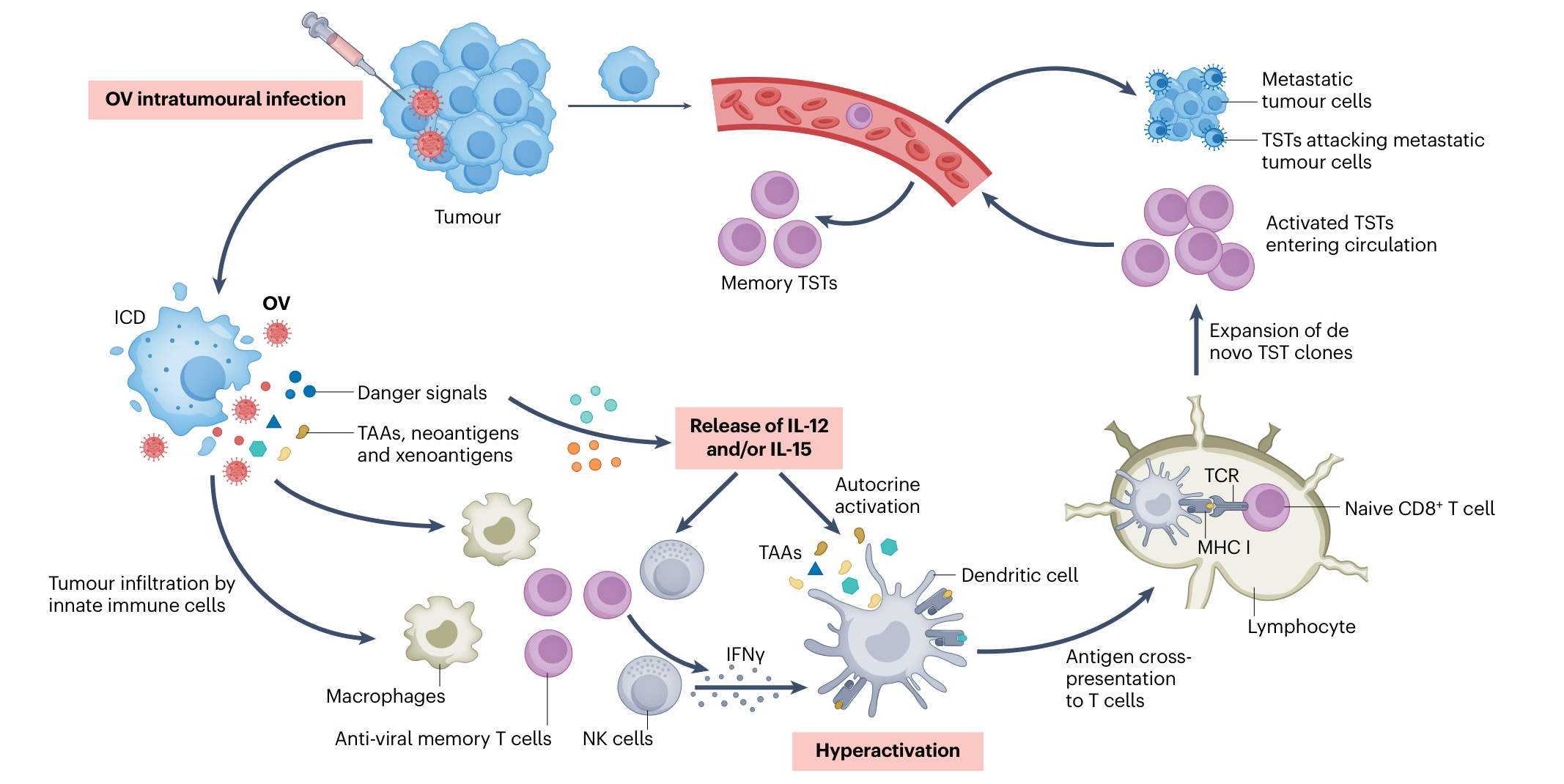
图 1 · 原位疫苗与工程载荷。原文 PDF 第 7 页。
载荷的选择还涉及抗肿瘤反应与抗病毒反应之间的平衡;免疫刺激的增强方向随病毒、肿瘤和宿主环境变化(第 8 页)。
Triple-A:连接 T 细胞的三个环节
作者用 availability、activation、admission 描述有效免疫需要衔接的三个环节:肿瘤特异性 T 细胞是否可用、是否激活、能否进入肿瘤(PDF 第 11 页)。
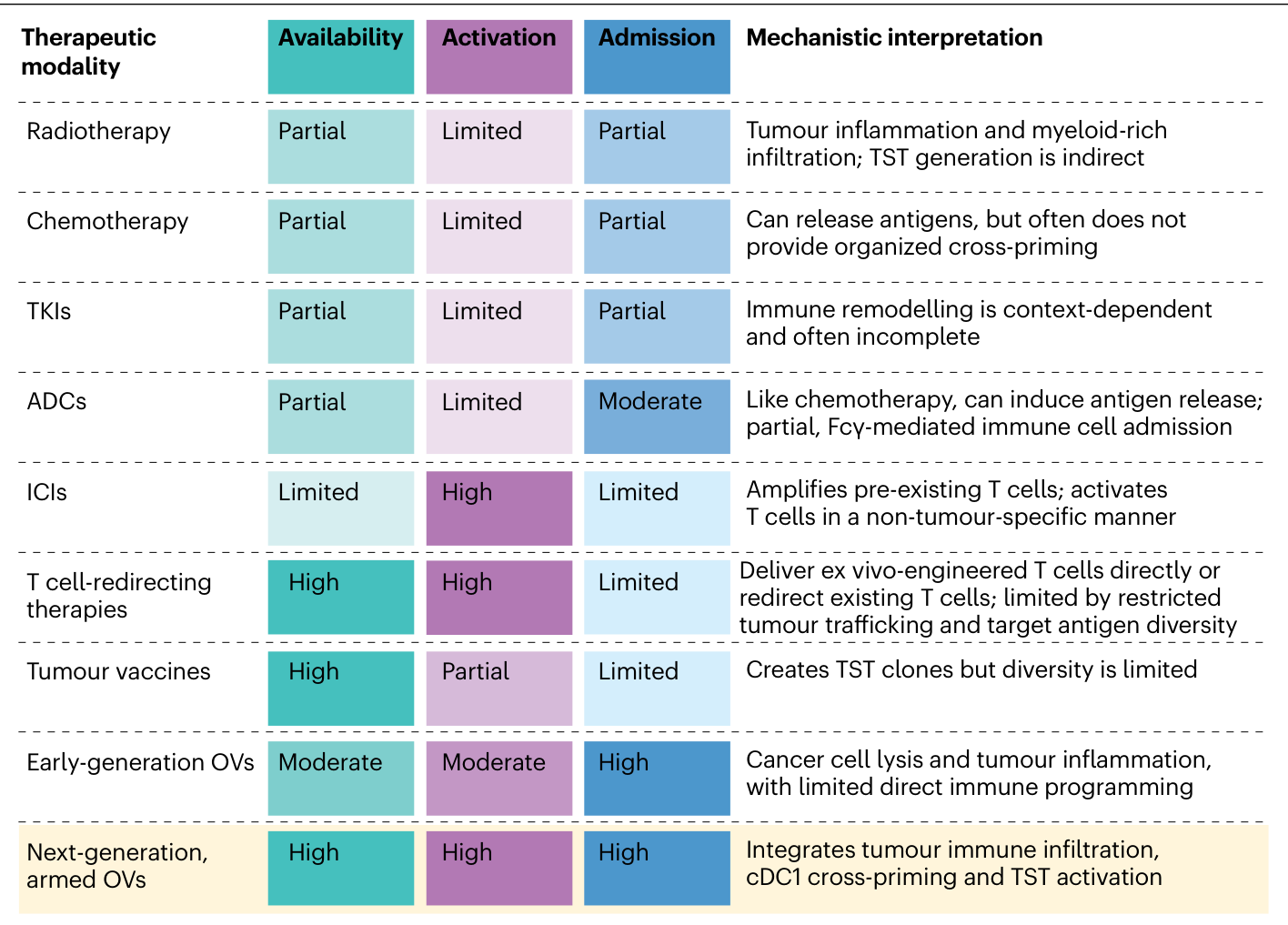
图 2 · T 细胞可用、激活与进入肿瘤的概念框架。原文 PDF 第 11 页。
这一框架也引出了作者提出的序贯思路:先由病毒启动免疫,再由检查点抑制剂放大反应。给药顺序的优势仍待直接随机比较(第 12–13 页)。
联合治疗的临床进展
早期研究提供了免疫浸润与联合应答信号,但 MASTERKEY-265 的 III 期研究未显示 PFS 或 OS 的显著改善(PDF 第 12–13 页)。下一步的关键是识别适合的人群、载荷与治疗时序,而非将不同方案视为同一种联合策略。
值得持续关注的方向
- 抗原特异性: 结合 TCR 谱系与功能实验,追踪治疗引起的免疫变化(第 4–5、15–16 页)。
- 工程载荷与时序: 把局部免疫启动、抗病毒清除和检查点干预放进时间维度(第 6–8、12–13 页)。
- 疗效读出: 联合观察 ctDNA、未注射病灶和持久应答,并与长期生存联系(第 15–16 页)。
原始文献线索:MASTERKEY-265 III 期试验(ref. 29);Ribas 等关于瘤内 T 细胞浸润与抗 PD-1 联合的研究(ref. 19);VG161 难治性肝细胞癌研究(ref. 28)。
主图与表格 · 3 张
Fig. 1 · PDF 第 7 页
Fig. 1 | Oncolytic viruses for in situ vaccination. Oncolytic viruses (OVs) can exert antitumour immune responses through a multilayered mechanism that extends beyond direct cytolysis. Upon intratumoural infection, whether following direct intratumoural injection or intravenous delivery, immunogenic cell death (ICD) induces danger signals that recruit innate immune effectors, including natural killer (NK) cells, macrophages and dendritic cells (DCs), into the tumour mass, converting an immunologically ‘cold’ tumour into an active inflammatory site. Concurrent OV-mediated lysis of cancer cells releases tumour-associated antigens (TAAs) and immunostimulatory signals such as damage-associated or pathogen-associated molecular patterns into the microenvironment. Importantly, next-generation OVs are engineered to express transgenes encoding immunostimulatory payloads within the tumour, leveraging the infected cell as an in situ cytokine factory. Intratumoural expression of cytokines such as IL-12 and IL-15 can activate DCs through multiple synergistic pathways: first, by stimulating infiltrating natural killer (NK) cells and T cells to release IFNγ, the most potent known DC activator; and second, by directly engaging cognate receptors on DCs via autocrine signalling. Together, these mechanisms drive DCs to a hyperactivated state, thereby enabling efficient cross-presentation of otherwise weakly immunogenic TAAs to naive CD8+ T cells; this cross-priming is a crucial bottleneck in generating de novo tumour- specific T cell (TST) responses. A third, mechanistically distinct step operates once cross-presentation has occurred: IL-12 released by the DC itself serves as an essential ‘third signal’ delivered directly to the T cell during the priming interaction, alongside T cell receptor activation by cognate peptide–MHC (signal 1) and costimulatory signalling via CD28 (signal 2); without this third signal, naive CD8+ T cells undergo only limited proliferation and fail to develop effector function, becoming tolerant rather than productively primed92,93. A likely under-appreciated dimension of OV immunobiology involves the recruitment of pre-existing antiviral memory T cells to the infected tumour. When re-stimulated by viral antigens and IL-12 and/or IL-15, these cells produce high levels of IFNγ, further amplifying DC activation — a mechanism that might be particularly important for unarmed OVs lacking transgenic immunostimulatory payloads. Collectively, antigen release, payload-driven DC licensing and antiviral memory T cell-mediated IFNγ signalling converge to drive DC hyperactivation, positioning armed OVs as uniquely capable of overcoming the dual barriers of antigen ignorance and immune exclusion that constrain the efficacy of systemic immunotherapies. TCR, T cell receptor.
Fig. 2 · PDF 第 11 页
Fig. 2 | Triple-A gate model for productive antitumour immunity across therapeutic modalities. To simplify the multistep cancer–immunity cycle described by Chen and Mellman59, we consolidated these requirements into the ‘triple-A’ principle shown here: (1) availability (generation of tumour-specific T cell (TST) clones); (2) activation of TST clones in response to their cognate tumour-associated antigens presented by cancer cells; and (3) admission (immune effector cell infiltration into the tumour microenvironment). A therapeutic modality must clear these three sequential mechanistic gates to generate durable, tumour-specific antitumour immunity. For each modality, shading intensity within each gate column denotes the degree of fulfilment (limited < partial < moderate < high). Radiotherapy146, chemotherapy147 and tyrosine-kinase inhibitors (TKIs)148 induce predominantly myeloid-cell infiltration (partial admission) and can release tumour antigen (partial availability), but do not directly activate T cells (limited activation). Antibody– drug conjugates (ADCs) combine a chemotherapy-like cytotoxic payload, which partially fulfils availability through immunogenic antigen release150, with an antibody component that engages Fcγ receptors on innate effectors to partially fulfil admission (moderate)151; ADCs do not directly activate TST clones. Immune checkpoint inhibitors (ICIs) amplify pre-existing T cell activity (high activation) but do not directly drive immune infiltration or generate new TST clones de novo3 (limited admission and availability). T cell-redirecting therapies, including chimeric antigen receptor T cells, T cell receptor- engineered T cells and bispecific T cell engagers bypass endogenous TST priming by supplying ex vivo-expanded and/or redirecting endogenous T cells to target specific tumour-associated antigens (high availability and activation), but remain constrained by poor tumour trafficking and antigen loss owing to their lack of target antigen diversity152–154,205. Tumour vaccines generate TST clones (high availability) but of limited diversity, and vaccine-primed T cells encounter barriers to tumour entry149 (limited admission; partial activation). Early-generation oncolytic viruses (OVs) induce lysis and inflammation but have limited capacity for direct immune reprogramming (high admission; moderate availability and activation)69,70,114. Next-generation, payload-armed OVs uniquely achieve high fulfilment of all three gates simultaneously, including conventional dendritic cell (cDC1) hyperactivation and cross-priming for TST availability54,61,71, positioning them as a mechanistic cornerstone for combination immunotherapy.
Table 1 · PDF 第 5 页
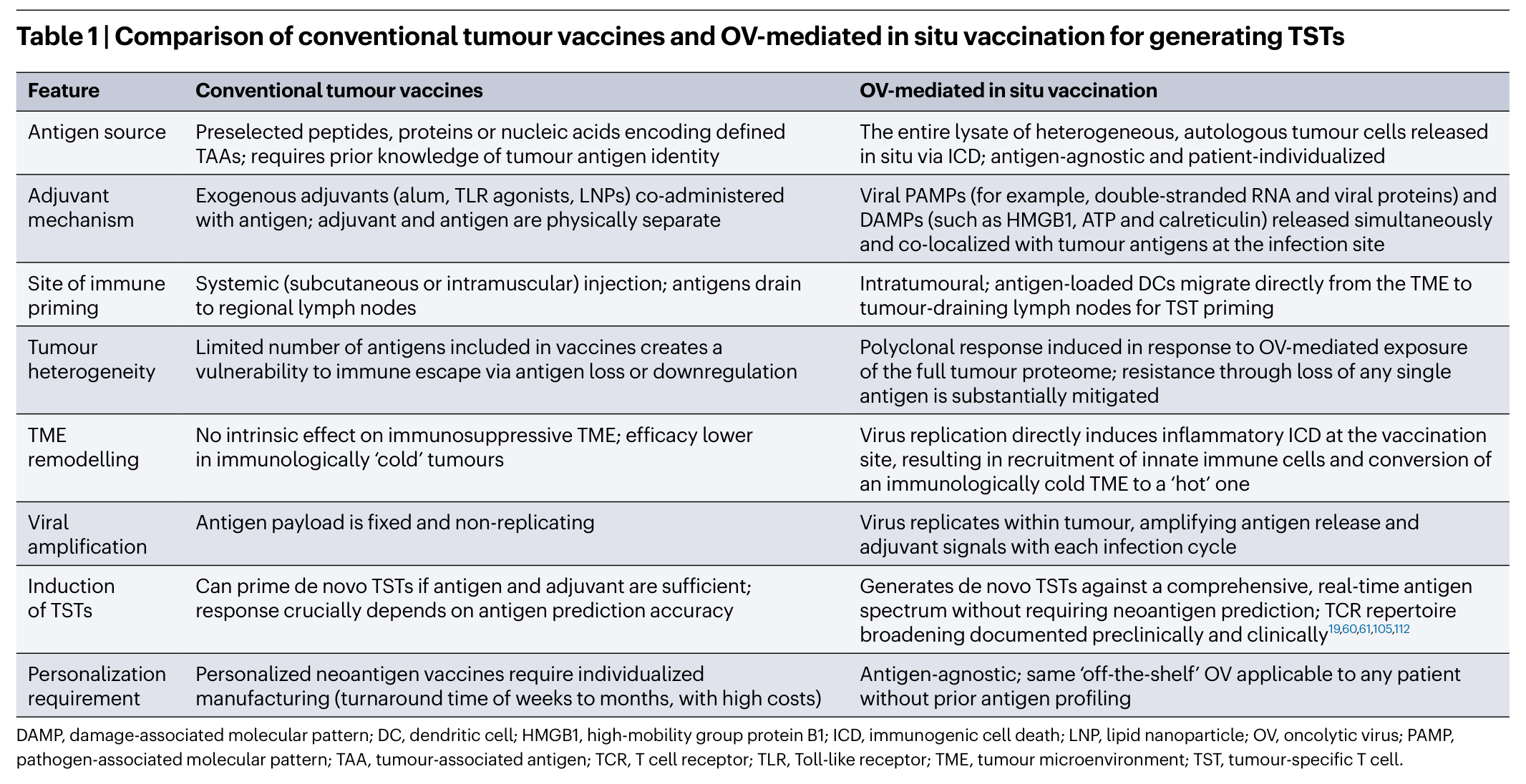
表题与脚注见截图。
完整阅读记录与证据表
文献卡:Beyond cold to hot: oncolytic virotherapy as the next cornerstone of immuno-oncology
- Paper ID:p-0003-rev-beyond-cold-hot-oncolytic-virotherapy
- 分析日期:2026-09-08;技能:review-read
- 原文类型:Perspective;期刊:Nature Reviews Clinical Oncology
- 阅读覆盖:PDF 共20页。第1–16页正文、表1和图1–2图注已读;图1(第7页)与图2(第11页)已视觉查看。第16–20页参考文献仅定位追读条目,第20页利益冲突已读。独立Supplementary Tables 1–2未提供;本文转述的原始研究和监管状态未独立核验。
- 人工核对:pending(待核对)
- 本卡页码均为从1开始的PDF页序。
一句话结论
这篇 Perspective 主张把下一代溶瘤病毒理解为瘤内原位免疫启动平台,关注肿瘤特异性T细胞的产生、激活和进入肿瘤;“OV先启动、ICI再放大”是待前瞻性验证的策略框架,不是已确立的普遍临床优势(PDF第4–16页,图1–2)。
研究问题与背景
仅让肿瘤从“冷”变“热”,能否保证产生有效的肿瘤特异性免疫?作者认为细胞浸润不等于抗原特异性,也不等于长期生存获益,提出把评价重点前移至免疫启动(第2、4–5页)。
贡献与比较对象
将既有临床试验、临床前机制及作者推论组织成四支柱,并用 triple-A 框架比较治疗方式。图2中的等级是作者概念归类,不是头对头疗效排名(第11页)。原文类型为Perspective;按本项目rev归档,不应称为系统综述或Meta分析。
范围与选文方法
覆盖溶瘤病毒历史、免疫启动、工程载荷、终点选择和联合治疗。正文没有报告可复现的系统检索式、纳排标准或风险偏倚评估;引用了其他Meta分析,不代表本文自行进行了Meta分析(第2–4页)。外部Supplementary Tables 1–2未随本地文件提供。下述临床数字均为本文转述,本次没有直接核查原始试验或最新监管文件。
分类体系与代表工作
| 主张或结果 | 数字、单位、条件 | PDF页序/图表 | 依据类型 | 核对状态 |
|---|---|---|---|---|
| 支柱1:原位疫苗 | 释放抗原与危险信号、经DC启动T细胞;新出现TCR克隆仍需验证肿瘤抗原特异性 | 第4–5、7页图1 | 作者框架+转述;图已查看 | 待人工核对 |
| 临床早期信号 | G47Δ胶质母细胞瘤单臂II期n=19,1年生存84.2%,中位OS 20.2个月;历史对照不是同期随机对照 | 第5页,ref.42 | 转述 | 原始试验尚未核查 |
| 支柱2:载荷驱动启动 | IL-12、IL-15等增强免疫刺激;不保证选择性指向肿瘤抗原 | 第6–8页图1 | 作者框架+转述 | 待人工核对 |
| 支柱3:终点要区分应答持久性与远隔效应 | OPTiM中T-VEC组23/295(7.8%)先进展再应答;持久应答者中23/48(48%) | 第9页,ref.120 | 转述 | 注意两个分母 |
| 支柱4:联合治疗与triple-A | availability、activation、admission;定性机制模型 | 第11页图2 | 作者概念图,已查看 | 不是定量疗效比较 |
| 支持与反例必须并列 | MASTERKEY-265早期阶段ORR 62%;III期未显著改善PFS或OS | 第12–13页,refs.19、29 | 转述 | 跨阶段比较有混杂 |
| 作者支持序贯但尚未直接证明 | T-VEC+ipilimumab研究ORR 39%对18%;没有直接随机比较给药顺序 | 第13页,refs.162–163 | 转述+作者假说 | 不将跨试验差异解释为顺序的因果效应 |
| 生物标志物为辅助终点 | ctDNA、TCR谱系、DC亚群、未注射病灶和长期OS | 第15–16页 | 作者建议+转述 | OV中特别需验证替代终点有效性 |
争议与开放问题
- “治疗后才检测到的TCR克隆”究竟是初次启动、原本低丰度克隆扩增,还是抗病毒克隆?第4页承认直接肿瘤特异性交叉启动的机制证明主要来自临床前模型;第5、11页的强措辞应与这一边界一起读。
- “序贯比同期更好”尚无直接随机顺序比较。药物、入组人群、操作者和试验规模均可解释不同试验结果(第12–13页)。
- SD可能反映肿瘤自然生长缓慢;持久SD、未注射病灶、ctDNA变化也不能在未经验证时替代OS(第9–10、16页)。
- 载荷增强免疫既可能增强抗肿瘤,也可能增强抗病毒反应;作者在第8页明确承认其偏向具有情境性。
局限
作者明确指出
小规模、单臂、异质队列以及缺少直接抗原特异性验证限制结论;需足够效能的随机试验。瘤内与静脉给药缺少严谨头对头比较;ctDNA作为OV替代终点仍需验证(第10、13、15–16页)。
AI 推断与理由
- 不能用机制合理性解释掉阴性III期结果;阴性结果必须保留。
- 不能把T细胞浸润、TCR多样性、未注射病灶缩小三者混为“已证实从零产生特异性克隆”。
- 第20页披露两位作者任职Virogin,另一位任职Ankyra,另一位持Virogin期权;这提示需特别核对证据选择和推论强度,不构成否定研究的理由。
- 第3、10、12页的RP1应答率涉及不同分析人群/读出版本;本次不将这些百分比拼成单一最终结果,也不据该PDF确认2026年监管状态。
优先追读清单
研究方向未给定,按验证本文核心论点的重要性与研究设计排序;以下均为尚未核查的原始研究,仅依据本文参考文献定位。
- Chesney et al. Randomized, double-blind, placebo-controlled, global phase III trial of talimogene laherparepvec combined with pembrolizumab for advanced melanoma(第16页ref.29):优先理解阴性III期结论。
- Ribas et al. Oncolytic virotherapy promotes intratumoral T cell infiltration and improves anti-PD-1 immunotherapy(第16页ref.19;DOI 10.1016/j.cell.2017.08.027):核对早期机制证据与样本规模。
- Andtbacka et al. Final analyses of OPTiM: a randomized phase III trial of talimogene laherparepvec versus granulocyte-macrophage colony-stimulating factor in unresectable stage III-IV melanoma(第17页ref.41;DOI 10.1186/s40425-019-0623-z):核对应答与持久性终点。
- Shen et al. Oncolytic virus VG161 in refractory hepatocellular carcinoma(第16页ref.28;DOI 10.1038/s41586-025-08717-5):区分探索性相关和因果治疗效果。
- Todo et al. Intratumoral oncolytic herpes virus G47∆ for residual or recurrent glioblastoma: a phase 2 trial(第17页ref.42;DOI 10.1038/s41591-022-01897-x):核对单臂生存数据及历史对照。
待核对问题与后续阅读
补充表1–2;新克隆的抗原特异性验证;各试验分母、终点与分析日期;原文在线发表日期占位符。涉及药品批准或实际临床决策时,必须另外核对正式监管来源,本卡仅记录PDF内容。
人工补充
待人工填写;本次未创建或覆盖 discussion.md。